TL;DR: ChatGPT can answer questions — but it can’t take action. AI agents represent the next evolution of automation: systems that not only understand context but execute tasks, coordinate workflows, and make decisions across your tools. They’re the true bridge between AI insight and operational execution.
When ChatGPT exploded into the mainstream, it redefined how people thought about AI. Suddenly, anyone could have a fluent, intelligent conversation with a machine — brainstorming ideas, drafting documents, and generating code on demand.
But there’s one thing ChatGPT doesn’t do: work.
It can tell you how to automate an invoice, but it won’t log into your ERP and process it. It can summarize your sales pipeline, but it won’t update Salesforce.
That’s where AI agents enter the picture — the next step in AI’s evolution from talking to doing.
ChatGPT represents a major leap forward in natural language understanding, but its design is fundamentally conversational. It’s brilliant at generating content and answering questions, but it operates in isolation — disconnected from your company’s systems and workflows.
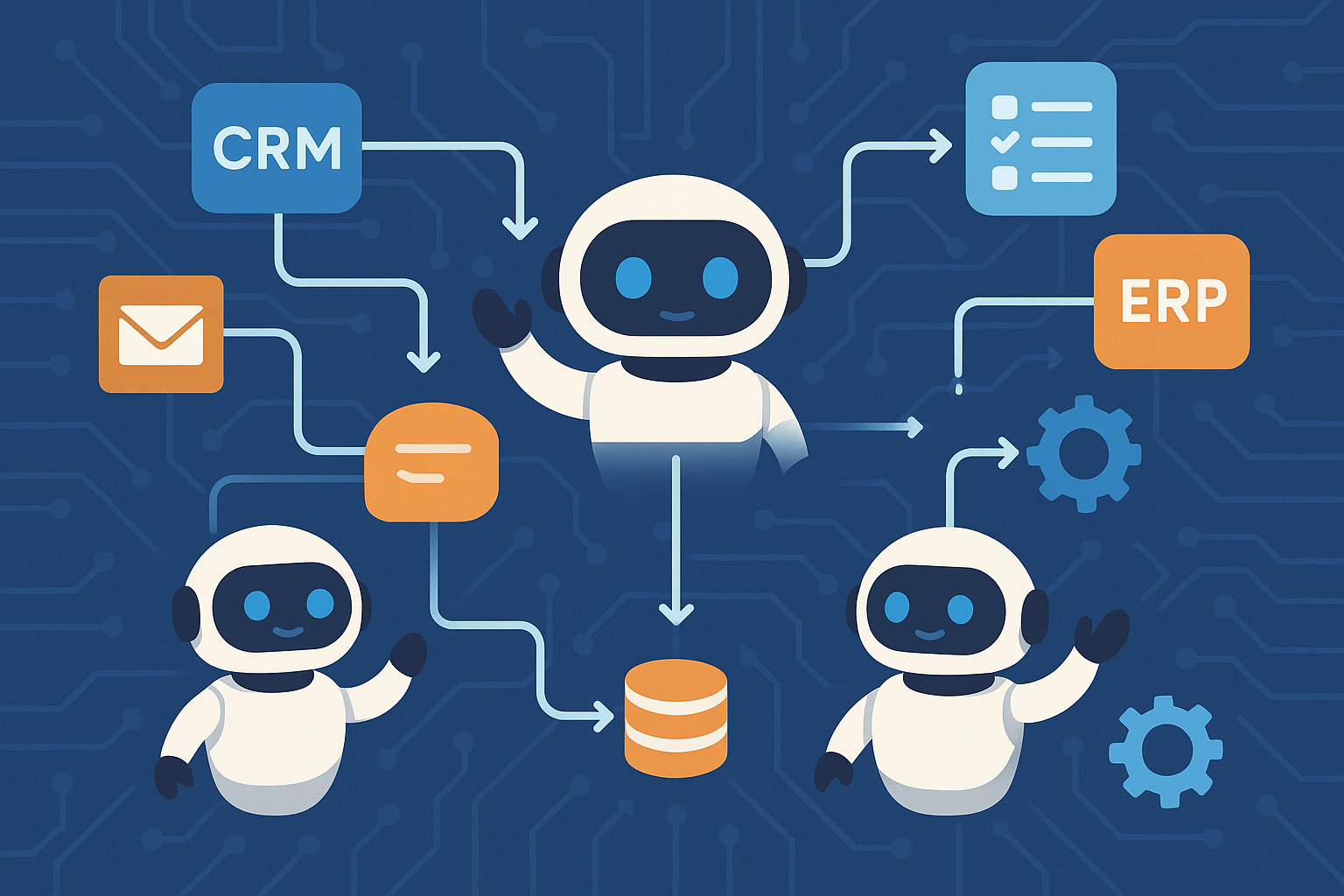
AI agents, on the other hand, are designed to integrate deeply into your organization’s operations. They don’t just respond — they act.
They can:
In short, they’re autonomous digital co-workers — not assistants waiting for instructions, but operators executing real work across departments.
ChatGPT (and similar conversational AIs) deliver immense value for ideation and communication. But in the enterprise, they face critical limitations:
That’s why most organizations experimenting with conversational AI find that it’s powerful — but incomplete. To move from answers to actions, you need something more structured and embedded.
Enter: AI agents.
AI agents are autonomous software systems that perceive their environment, make decisions, and act toward defined goals. In enterprise contexts, that means performing structured, repeatable work across systems.
Unlike traditional bots, AI agents combine:
As Tonkean explains in its popular AI Agents vs. ChatGPT webinar, “ChatGPT gives you answers. AI agents deliver outcomes.”
Where ChatGPT stops at text generation, agents go further — logging tickets, routing approvals, filing invoices, or even coordinating between human teams and automated systems.
Traditional automation tools — like RPA or rule-based scripts — follow strict patterns. They’re efficient, but brittle: one system update or edge case, and the automation fails.
AI agents bring flexibility, context, and intelligence to automation. They can:
This marks the shift from automating tasks to orchestrating work.
Pipefy calls this movement “agentic orchestration” — where AI agents act as the connective tissue between people, processes, and platforms, ensuring that everything happens in the right order, at the right time.
Consider a mid-size enterprise’s procurement workflow — often slow, manual, and scattered across email, spreadsheets, and approvals.
With AI agents in place:
What used to take hours — and multiple human touchpoints — now happens autonomously in minutes.
Organizations applying similar AI-agent-driven automation report:
The emergence of AI agents is made possible by three converging trends:
This ecosystem enables agents to function as autonomous operators rather than passive assistants — capable of real, auditable, repeatable work.
| Feature | ChatGPT | AI Agents |
|---|---|---|
| Primary Function | Conversational and generative | Task execution and workflow orchestration |
| Integration Depth | Limited (via plugins) | Deep, system-level integration |
| Decision-Making | Reactive (based on prompts) | Proactive (based on conditions and data) |
| Governance | Informal | Enforces business rules and compliance |
| Outcome | Information | Action |
While ChatGPT provides knowledge, AI agents deliver execution. The two aren’t competitors — they’re complementary parts of a smarter automation strategy.
We’re entering a new phase of workplace automation — one where human creativity and AI execution converge.
In this hybrid model, every team member (human or digital) knows what needs to happen next. The result is consistent execution, higher velocity, and fewer operational blind spots.
For operations, finance, and IT leaders, AI agents represent the next major efficiency frontier. They:
Organizations adopting agentic automation early will gain a clear competitive advantage — not just in speed, but in adaptability.
As processes evolve, AI agents learn and scale alongside the organization, ensuring automation doesn’t just keep up — it leads.
In 2023, everyone talked about ChatGPT. In 2025, the conversation is shifting to AI agents — systems that can do the work, not just describe it.
Where conversational AI democratized access to intelligence, AI agents will democratize execution.
That’s the real revolution: automation that thinks, acts, and adapts — turning AI from a clever assistant into a true operational partner.
For organizations ready to move beyond the hype, the future of work is already here — it’s just quietly running in the background, orchestrated by agents.